
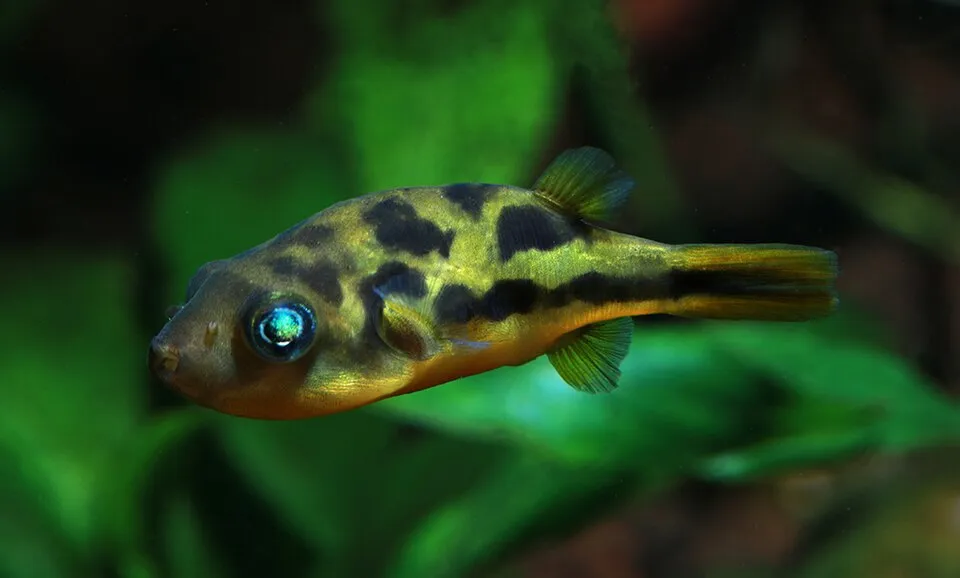
Pea Puffer
Carinotetraodon travancoricus
Also known as Dwarf Pufferfish, Malabar Puffer
Edited by Ivan F. · Reviewed
Beginner verdict
The world's smallest pufferfish, full of curiosity and personality, but it is not a community fish. It nips slow or long-finned fish and hunts snails and shrimp. Give it a heavily planted tank of its own, plenty of sight breaks, and a meaty, varied diet.
Care at a glance
- Min tank size
- 3.3 US gal
- Footprint
- 12 x 8 in
- Temperature
- 72–82 °F
- pH
- 6.8–8
- Hardness
- 5–25 dGH
- Swim zone
- Mid-Water
- Min group
- Single fish
- Lifespan
- 4–5 years
Pea Puffer care mistakes to avoid
The mistakes beginners most often make with this species.
- Plan on one as the centerpiece of the tank, and read the tank-mate lists before adding others.
- Do not keep it with slow or long-finned fish, because it nips fins.
- Expect snails and shrimp to be eaten. They are natural food.
- Add plenty of plants and sight breaks, which reduce fighting between puffers.
- Check your tank before you buy. Our sourced minimum is 3.3 US gallons.
Pea Puffer tank mates and swim zone

Mid-Water
Spends most of its time in this part of the tank.
Otocinclus macrospilus
Paracheirodon innesi
Pea Puffer often does best alone. Only try this in a larger, planted tank, and watch closely.
Paracheirodon axelrodi
Pea Puffer often does best alone. Only try this in a larger, planted tank, and watch closely.
Hyphessobrycon herbertaxelrodi
Pea Puffer often does best alone. Only try this in a larger, planted tank, and watch closely.
Hemigrammus erythrozonus
Pea Puffer often does best alone. Only try this in a larger, planted tank, and watch closely.
Hyphessobrycon amandae
Puffers are nippy hunters, and a fish this small is an easy target.
Boraras brigittae
Pea Puffer is fast and nippy and will bully a timid little fish like Chili Rasbora.
Danio margaritatus
Pea Puffer is fast and nippy and will bully a timid little fish like Celestial Pearl Danio.
Poecilia wingei
Pea Puffer is fast and nippy and will bully a timid little fish like Endler's Livebearer.
Pea Puffer feeding and care
How to feed
- Feed live or frozen foods. Most refuse dry food entirely.
- Offer small snails often, which also help keep its teeth worn down.
- Feed small portions you can see finished within a couple of minutes, because overfeeding fouls the water fast.
Telling males from females
Mature males show a clear dark line along the belly and often small lines behind the eye. Females are rounder with spots.
Plants that suit it
Species facts
- Family
- Tetraodontidae
- Native to
- Kerala and Karnataka, India
- Adult size
- 1 in (2.5 cm)
- Temperament
- Territorial/Aggressive
- Social needs
- Solitary/Centerpiece
- Diet
- Carnivore
- Water flow
- Gentle
- Substrate
- Any
- Live plants
- Yes - Loves Plants
- Shrimp
- Will Eat Shrimp
- Fin nipping
- High
- Vulnerable to nippers
- No
- Breeding
- Difficult in Home Tanks
Pea Puffer FAQ
What size tank do Pea Puffers need?
Our sourced minimum is 3.3 US gallons (12.6 liters), with a footprint of 30 x 20 cm. A bigger tank is always easier to keep stable.
How many Pea Puffers should I keep?
One is fine in a tank this size. Add more only with plenty of extra room and cover.
What can live with Pea Puffers?
Good matches on our list include Otocinclus Catfish. Avoid Ember Tetra and Chili Rasbora.
How long do Pea Puffers live?
Care guides report about 4–5 years. Stable water and a good diet make the biggest difference.
Can I keep more than one pea puffer?
Yes, but they can be territorial and need more room. Our figure is for one fish, so add plenty of space and sight-breaking plants for a group.
Where to buy Pea Puffer
Stores that list it under the same scientific name as this page. We earn nothing from these links. We have not bought from them, so check each store's own terms.
We have not found a store that sells Pea Puffer under its scientific name yet. We add stores as we confirm them.
Live animals and plants travel by courier. Check the store's live-arrival guarantee, and only buy once your tank has cycled (see how to cycle a fish tank).
Some US states restrict certain species. Check our US state aquarium rules table and your state's own rules before you buy.
Complete the tank
The essentials for a small, gently filtered tank.
Tank size for this species
At least 3.3 US gallons (12.6 L), 30 x 20 cm footprint
Filter
Air-driven sponge filter
Gentle flow that small fish and long fins can handle, plus a safe home for good bacteria.
Aquarium Co-Op Coarse Sponge Filter (Small) US
Fluval AquaClear 20 Power Filter US
Tetra Brillant Filter Spain
Fluval AquaClear 20 Power Filter Spain
Why we chose these (Best Filter for a 10-Gallon Tank). Nobody here has used or tested them.
Heater
Adjustable heater, about 5 W per gallon: 25 W at 5 gallons, 50 W at 10
Keeps a small tank stable. Adjustable models let you set the temperature your species needs. Size up for a cold room.
Fluval T50 Fully Electronic Aquarium Heater US
Aqueon Pro Adjustable Heater 50 W US
Fluval T50 Fully Electronic Aquarium Heater Spain
Eheim Thermocontrol e 50 Heater Spain
Why we chose these (Best Heater for a 10-Gallon Aquarium). Nobody here has used or tested them.
Water Conditioner
Dechlorinator such as Seachem Prime
Tap water contains chlorine or chloramine that harms fish.
Seachem Prime US
Fritz Complete Water Conditioner US
API Betta Water Conditioner US
sera aquatan Spain
Tetra AquaSafe Spain
Maker's page · Sold at Kiwoko · Sold at Tiendanimal · Sold at zooplus.es
Why we chose these (Best Water Conditioner for Betta Fish). Nobody here has used or tested them.
Test Kit
Liquid kit such as API Freshwater Master
Tracks ammonia, nitrite, nitrate and pH while the tank cycles.
API Freshwater Master Test Kit US
API General & Carbonate Hardness Test Kit US
Maker's page · Sold at The Shrimp Farm · Sold at Bulk Reef Supply
sera aqua-test box (Cl) Spain
JBL PROAQUATEST COMBISET Plus NH4 Spain
Why we chose these (Best Test Kit for a Freshwater Aquarium). Nobody here has used or tested them.
Cycle the tank before adding animals. See our guide on how to cycle a fish tank.