
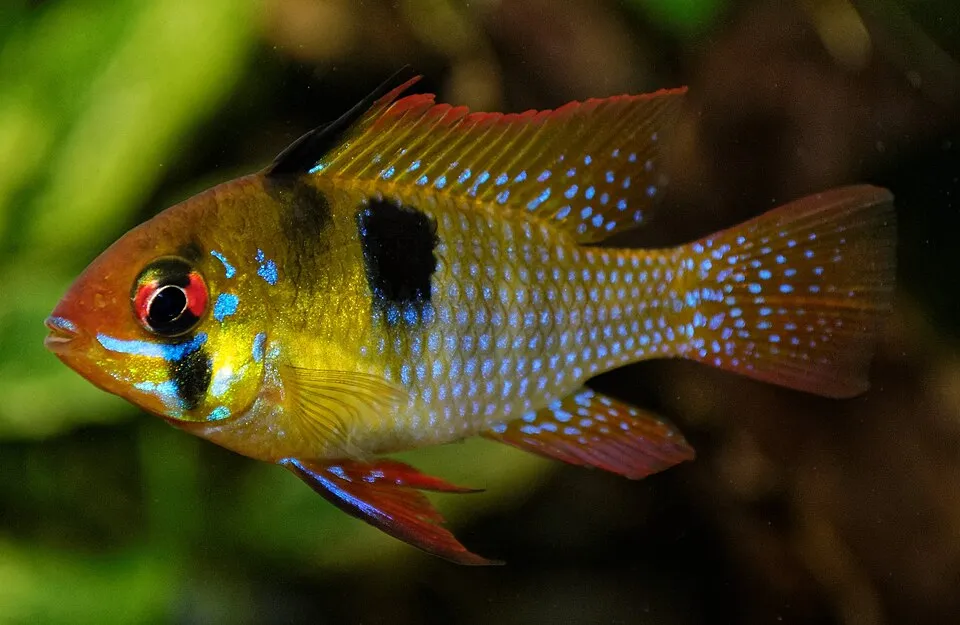
German Blue Ram
Mikrogeophagus ramirezi
Also known as Blue Ram, Ram Cichlid
Edited by Ivan F. · Reviewed
Beginner verdict
A dazzling small cichlid in electric blue and gold, but far more delicate than its price tag suggests. It needs very warm, soft, pristine water and is a poor competitor. Keep it only in a mature tank with calm schooling fish, and quarantine new arrivals with care.
Care at a glance
- Min tank size
- 14 US gal
- Footprint
- 24 x 12 in
- Temperature
- 81–86 °F
- pH
- 4–7
- Hardness
- 1–10 dGH
- Swim zone
- Bottom
- Min group
- 2 fish
- Lifespan
- About 4 years
German Blue Ram care mistakes to avoid
The mistakes beginners most often make with this species.
- Plan for a pair, and read up on sexing before you buy so you do not end up with two rival males.
- Add only to a mature tank, because it needs pristine water to survive.
- Keep it warm. It wants a higher temperature than most community fish.
- Check tank mates carefully, since few peaceful species share such warm water.
- Check your tank before you buy. Our sourced minimum is 14 US gallons.
German Blue Ram tank mates and swim zone

Bottom
Spends most of its time in this part of the tank.
Paracheirodon axelrodi
Trichopodus leerii
Hyphessobrycon amandae
Their temperature ranges barely overlap, so you will have little room for error.
Hyphessobrycon herbertaxelrodi
Their temperature ranges barely overlap, so you will have little room for error.
Hemigrammus erythrozonus
Their temperature ranges barely overlap, so you will have little room for error.
Trigonostigma heteromorpha
Their temperature ranges barely overlap, so you will have little room for error.
Paracheirodon innesi
Their temperature ranges do not overlap, so one of them would always be stressed.
Danio rerio
Their temperature ranges do not overlap, so one of them would always be stressed.
Danio margaritatus
Their temperature ranges do not overlap, so one of them would always be stressed.
Tanichthys albonubes
Their temperature ranges do not overlap, so one of them would always be stressed.
Barbodes semifasciolatus
Their temperature ranges do not overlap, so one of them would always be stressed.
German Blue Ram feeding and care
How to feed
- Feed small sinking pellets and granules.
- Offer frozen bloodworm, brine shrimp and daphnia to bring it into condition.
- Feed small portions you can see finished within a couple of minutes, because overfeeding fouls the water fast.
Telling males from females
Adult males grow larger, with longer fins and more intense color. Females usually show a rosy pink belly.
Plants that suit it
Species facts
- Family
- Cichlidae
- Native to
- Orinoco basin, Venezuela and Colombia
- Adult size
- 1.6 in (4 cm)
- Temperament
- Peaceful
- Social needs
- Harem/Pairs
- Diet
- Omnivore
- Water flow
- Gentle
- Substrate
- Fine Sand Required
- Live plants
- Yes - Loves Plants
- Shrimp
- Will Eat Shrimp
- Fin nipping
- None
- Vulnerable to nippers
- Yes
- Breeding
- Moderate
German Blue Ram FAQ
What size tank do German Blue Rams need?
Our sourced minimum is 14 US gallons (54 liters), with a footprint of 60 x 30 cm. A bigger tank is always easier to keep stable.
How many German Blue Rams should I keep?
A pair works well. Add more only if the tank is large enough for each fish to claim its own space.
What can live with German Blue Rams?
Good matches on our list include Cardinal Tetra and Pearl Gourami. Avoid Neon Tetra and Zebra Danio.
How long do German Blue Rams live?
Care guides report about 4 years. Stable water and a good diet make the biggest difference.
Why do my German blue rams keep dying?
Water quality and temperature are the usual causes. Heavily inbred stock is also fragile, so buy from a careful seller and keep the tank warm and clean.
Where to buy German Blue Ram
We have not found a store that sells German Blue Ram under its scientific name yet. We add stores as we confirm them.
Live animals and plants travel by courier. Check the store's live-arrival guarantee, and only buy once your tank has cycled (see how to cycle a fish tank).
Some US states restrict certain species. Check our US state aquarium rules table and your state's own rules before you buy.
Complete the tank
A forgiving setup with room for a small community.
Tank size for this species
At least 14 US gallons (54 L), 60 x 30 cm footprint
Filter
Hang-on-back or large sponge filter
Easy to maintain and strong enough for a community without blasting the fish.
We are still choosing products for this.
Heater
Adjustable heater, about 5 W per gallon: 100 W at 20 gallons, about 150 W at 29
Enough power to hold a stable temperature in most homes. Size up for a cold room.
We are still choosing products for this.
Water Conditioner
Dechlorinator such as Seachem Prime
Tap water contains chlorine or chloramine that harms fish.
Seachem Prime US
Fritz Complete Water Conditioner US
API Betta Water Conditioner US
sera aquatan Spain
Tetra AquaSafe Spain
Maker's page · Sold at Kiwoko · Sold at Tiendanimal · Sold at zooplus.es
Why we chose these (Best Water Conditioner for Betta Fish). Nobody here has used or tested them.
Test Kit
Liquid kit such as API Freshwater Master
Tracks ammonia, nitrite, nitrate and pH while the tank cycles.
API Freshwater Master Test Kit US
API General & Carbonate Hardness Test Kit US
Maker's page · Sold at The Shrimp Farm · Sold at Bulk Reef Supply
sera aqua-test box (Cl) Spain
JBL PROAQUATEST COMBISET Plus NH4 Spain
Why we chose these (Best Test Kit for a Freshwater Aquarium). Nobody here has used or tested them.
Cycle the tank before adding animals. See our guide on how to cycle a fish tank.