
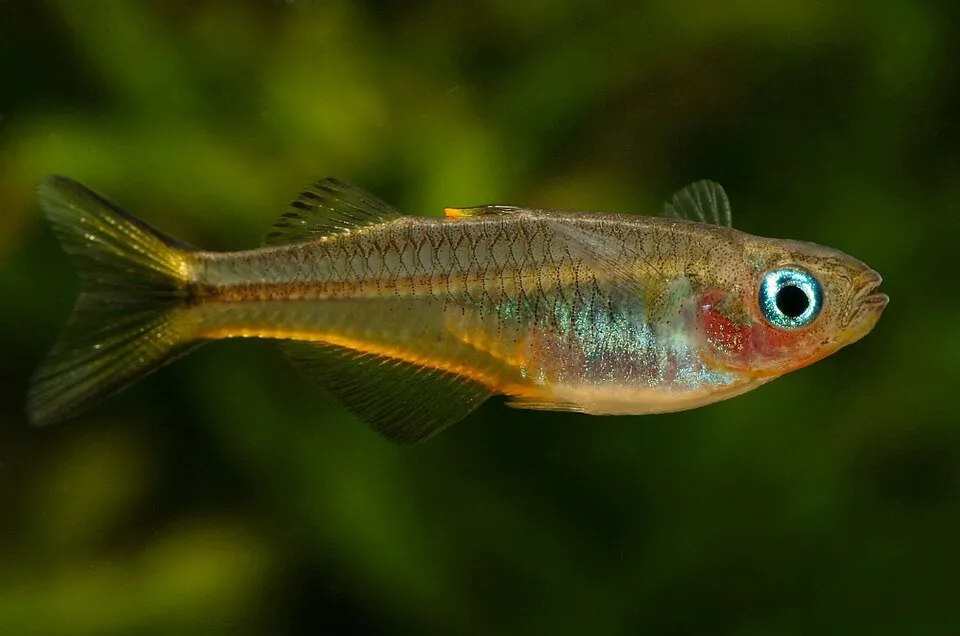
Forktail Blue-Eye Rainbowfish
Pseudomugil furcatus
Also known as Popondetta Blue-Eye, Furcata Rainbowfish
Edited by Ivan F. · Reviewed
Beginner verdict
A small, surface-loving fish with bright blue eyes and yellow fins that fork at the tail. It is peaceful and suits a densely planted tank alongside fish of similar size. It prefers harder water than many small fish, so check your tap before you buy.
Care at a glance
- Min tank size
- 14 US gal
- Footprint
- 24 x 12 in
- Temperature
- 75–82 °F
- pH
- 7–8
- Hardness
- 15–30 dGH
- Swim zone
- Top
- Min group
- 8 fish
- Lifespan
- Not well documented
Forktail Blue-Eye Rainbowfish care mistakes to avoid
The mistakes beginners most often make with this species.
- Do not buy just one or two. Keep at least 8 fish so they feel secure.
- Check your water first. It prefers hard water that many soft-water fish dislike.
- Avoid nippers and large fish, because its fine fins and small size make it an easy target.
- Keep a shoal with both sexes, which encourages daily display and better color.
- Check your tank before you buy. Our sourced minimum is 14 US gallons.
Forktail Blue-Eye Rainbowfish tank mates and swim zone

Top
Spends most of its time in this part of the tank.
Hemigrammus erythrozonus
Puntius titteya
Corydoras aeneus
Corydoras aeneus (albino)
Crossocheilus oblongus
Apistogramma borellii
Danio rerio
Their temperature ranges barely overlap, so you will have little room for error.
Danio margaritatus
Celestial Pearl Danio is small and shy, and is easily outcompeted for food by Forktail Blue-Eye Rainbowfish.
Barbodes semifasciolatus
Their temperature ranges barely overlap, so you will have little room for error.
Poecilia wingei
Endler's Livebearer is small and shy, and is easily outcompeted for food by Forktail Blue-Eye Rainbowfish.
Hyphessobrycon herbertaxelrodi
One needs much harder water than the other can tolerate.
Forktail Blue-Eye Rainbowfish feeding and care
How to feed
- Feed small floating foods near the surface, where it naturally hunts.
- Offer baby brine shrimp or daphnia often, as it mostly eats tiny prey.
- Feed small portions you can see finished within a couple of minutes, because overfeeding fouls the water fast.
Telling males from females
Males are more colorful, with fins that grow longer as they mature. Females are smaller and plainer.
Plants that suit it
Species facts
- Family
- Pseudomugilidae
- Native to
- Eastern Papua New Guinea
- Adult size
- 2.4 in (6 cm)
- Temperament
- Peaceful
- Social needs
- Schooling/Shoaling (6+)
- Diet
- Micro-Predator
- Water flow
- Gentle
- Substrate
- Any
- Live plants
- Yes - Loves Plants
- Shrimp
- Adult Shrimp Only
- Fin nipping
- None
- Vulnerable to nippers
- Yes
- Breeding
- Moderate
Forktail Blue-Eye Rainbowfish FAQ
What size tank do Forktail Blue-Eye Rainbowfish need?
Our sourced minimum is 14 US gallons (54 liters), with a footprint of 60 x 30 cm. A bigger tank is always easier to keep stable.
How many Forktail Blue-Eye Rainbowfish should I keep?
Keep at least 8 fish. Bigger groups usually look better and behave more confidently.
What can live with Forktail Blue-Eye Rainbowfish?
Good matches on our list include Glowlight Tetra, Cherry Barb and Bronze Corydoras. Avoid Neon Tetra and Cardinal Tetra.
How long do Forktail Blue-Eye Rainbowfish live?
Lifespan is not well documented for this species. Stable water and a good diet help any animal live longer.
Are forktail blue-eyes good in a planted tank?
Yes. They do best in a densely planted tank, and fine-leaved plants give them somewhere to scatter their eggs.
Where to buy Forktail Blue-Eye Rainbowfish
Stores that list it under the same scientific name as this page. We earn nothing from these links. We have not bought from them, so check each store's own terms.
We have not found a store that sells Forktail Blue-Eye Rainbowfish under its scientific name yet. We add stores as we confirm them.
Live animals and plants travel by courier. Check the store's live-arrival guarantee, and only buy once your tank has cycled (see how to cycle a fish tank).
Some US states restrict certain species. Check our US state aquarium rules table and your state's own rules before you buy.
Complete the tank
A forgiving setup with room for a small community.
Tank size for this species
At least 14 US gallons (54 L), 60 x 30 cm footprint
Filter
Hang-on-back or large sponge filter
Easy to maintain and strong enough for a community without blasting the fish.
We are still choosing products for this.
Heater
Adjustable heater, about 5 W per gallon: 100 W at 20 gallons, about 150 W at 29
Enough power to hold a stable temperature in most homes. Size up for a cold room.
We are still choosing products for this.
Water Conditioner
Dechlorinator such as Seachem Prime
Tap water contains chlorine or chloramine that harms fish.
Seachem Prime US
Fritz Complete Water Conditioner US
API Betta Water Conditioner US
sera aquatan Spain
Tetra AquaSafe Spain
Maker's page · Sold at Kiwoko · Sold at Tiendanimal · Sold at zooplus.es
Why we chose these (Best Water Conditioner for Betta Fish). Nobody here has used or tested them.
Test Kit
Liquid kit such as API Freshwater Master
Tracks ammonia, nitrite, nitrate and pH while the tank cycles.
API Freshwater Master Test Kit US
API General & Carbonate Hardness Test Kit US
Maker's page · Sold at The Shrimp Farm · Sold at Bulk Reef Supply
sera aqua-test box (Cl) Spain
JBL PROAQUATEST COMBISET Plus NH4 Spain
Why we chose these (Best Test Kit for a Freshwater Aquarium). Nobody here has used or tested them.
Cycle the tank before adding animals. See our guide on how to cycle a fish tank.